
If you run a service business anywhere from Ponte Vedra to Riverside, you have probably seen the shift. Customers still need help, but they do not wait the way they used to. A homeowner with a broken AC in July or a new resident looking for a dentist will often contact several companies at once. They tend to choose whoever responds first.
Before we get into the details, let's define Speed-to-Lead in plain language and explain why it matters for local service businesses. This guide covers how these systems work, why fast response matters, the business math behind them, what a good system includes, and the common mistakes to avoid.
What Speed-to-Lead actually means
Speed-to-Lead is the time between when someone reaches out to your business and when they get a helpful response. That inquiry might come through a web form, missed call, chat, text, email, or booking request. The important moment is not when someone on your team notices the inquiry. It is when the customer gets useful information.
There are two response-time metrics worth knowing. Time to first attempt is how long it takes your business to respond. Time to first contact is how long it takes to actually reach the person. The second number affects revenue and is often slower than owners expect because calls go to voicemail, emails get missed, and forms sit unread.
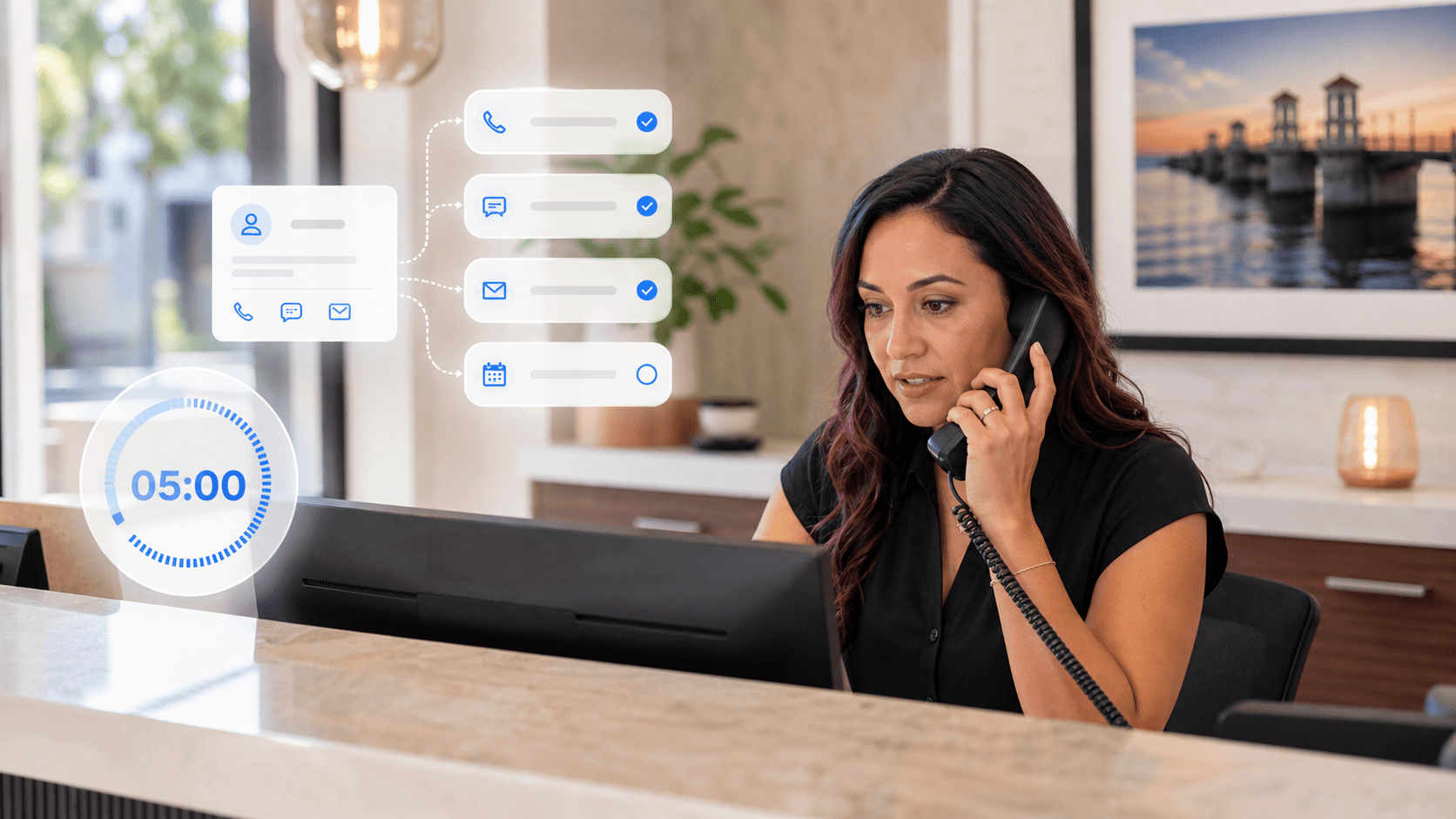
A Speed-to-Lead system shortens that gap by handling the first few tasks within seconds of an inquiry arriving:
- Capture: the lead's contact information and request are recorded immediately, even when staff are busy.
- Qualify: the inquiry is sorted by service type, location, urgency, budget, service area, or other rules that matter to your business.
- Route: the lead goes to the right person with the right context instead of landing in a shared inbox nobody owns.
- Confirm: the customer gets a quick, specific message that explains what happens next.
The main point is simple: this does not take over staff roles. It automates the critical first sixty seconds so your team can focus on better conversations with interested prospects.
Why response time matters more than most owners think
Research on lead response time has stayed remarkably consistent for years. The most-cited work originated with InsideSales, now XANT, in collaboration with academic researchers. Their research looked at thousands of leads and more than 100,000 contact attempts.
Two findings come up again and again:
- Responding within five minutes makes a business much more likely to reach and qualify a lead than waiting even thirty minutes.
- Conversion rates rise sharply when the first response happens in the first five minutes instead of hours later.
A widely cited XANT benchmark found that the average first-call response time was approximately forty hours, which is nearly two business days. You do not need the exact number to understand the point. Customers are most ready to act right after they reach out, and they often contact more than one company.
A slow response often loses to a faster competitor, not because the lead was poor, but because someone else replied sooner.
Sources: InsideSales Lead Response Research and the XANT Lead Response Report. Figures should be treated as established directional benchmarks, not guarantees for any single business.
Why this is especially true in Northeast Florida
National response-time data gives useful context, but St. Johns County and Jacksonville have local conditions that make speed even more important. Rapid growth in areas like Nocatee, Ponte Vedra, St. Augustine, and the World Golf Village corridor means more new residents are actively choosing providers for the first time.
Those customers often have no existing loyalty to an HVAC company, dentist, roofer, attorney, contractor, or local service provider. They search, compare, ask neighbors, fill out forms, and call more than one business. Jacksonville adds a large metro market right next door, making the region even more competitive.
In slower markets, taking time to follow up may be survivable. In this fast-moving local market, waiting two days often means losing leads to faster rivals. Lead generation may be working. The loss usually happens in the response phase.
The business math behind faster response
You can check the opportunity against your own numbers. Here is a simple dental clinic example. The same logic applies to HVAC, law, roofing, remodeling, or any business that depends on inbound leads.
$5,000
monthly ad spend
100
new-patient leads
12%
current close rate
25%
improved close rate
Suppose a clinic spends $5,000 per month on Google Ads and generates about 100 new-patient inquiries. The front desk is busy, so callbacks happen hours later or the next day. At that pace, the clinic books about 12% of those leads, or roughly 12 new patients per month.
Now introduce a Speed-to-Lead system. As soon as someone submits an appointment request, they receive a personalized text and email confirming the request and asking a qualifying question. The right team member is notified immediately with the full context. The ad spend, offer, and website copy stay the same. Only the response speed improves.
If that change raises the close rate from 12% to a conservative 25%, the clinic books about 25 patients instead of 12. That is 13 more patients each month with the same ad budget. Results vary by business, and specific outcomes are never guaranteed, but the principle is strong: improving conversion is usually cheaper than buying more leads.
To estimate the impact for your business, look at monthly lead count, current close rate, and average customer value. Then calculate the annual value of even a modest close-rate improvement. For many service businesses, the number makes response speed one of the first leaks worth fixing.
Which local businesses benefit most
Speed-to-Lead delivers the greatest benefit where missed inquiries become lost revenue and a quick response can secure the conversation:
- Home services:HVAC, plumbing, electrical, roofing, pest control, and pool service. Urgent problems, comparison shopping, and Florida's seasonal demand make speed critical.
- Dental and medical practices: new residents are often looking for providers, and each patient can carry strong long-term value.
- Law firms: high-value cases where the first firm to respond often earns the consultation.
- Real estate agents: buyers and sellers frequently contact multiple agents at once.
- Contractors and remodelers:inquiries tied to the county's construction and renovation activity.
If your business does not rely on inbound leads, these strategies may not apply. If it does, improving response speed can be a powerful growth lever that does not require more ad spend.
What a good system actually looks like
If you decide to build, buy, or outsource a system, focus on what improves customer response and team accountability. Impressive dashboards do not matter if the customer still waits.
Use this checklist when evaluating a Speed-to-Lead setup:
- List every lead channel: forms, calls, texts, chat, email, and social messages.
- Set automated alerts for the right person or role on each new lead.
- Write a short, specific auto-response for each major channel.
- Define qualifying rules by service type, service area, urgency, and fit.
- Route each inquiry to a clear owner, with a backup if that person is unavailable.
- Track response times and close rates before and after changes.
- Test the system with a mystery inquiry during and after business hours.
Good systems cover every channel
A form-only system may miss customers who call and reach voicemail, text your business line, or start a chat after hours. Missed calls and texts are often high-intent leads, not side cases.
Good auto-responses feel specific
A generic "thank you for your submission" does little to keep a customer engaged. A better message confirms the request and sets expectations: "Thanks for contacting us about a roof inspection. Someone from our team will call you within the hour."
Good qualification rules match real operations
The rules should fit your service area, preferred job types, team availability, and priority levels. A Jacksonville HVAC company might prioritize urgent repair requests from certain zip codes and route them to a senior technician. A St. Johns County dental office might route new-patient emergencies to a dedicated coordinator while cleanings go to general scheduling.
Each lead should go to a specific person or role, with a backup. If the process depends on "the team will see it," leads often get lost in the shuffle.
Good systems are measurable
You should be able to see response time, contact attempts, source, owner, status, and conversion rate before and after implementation. Without measurement, it is hard to know whether the system is creating value or just adding activity.
Common mistakes to avoid
Businesses that adopt Speed-to-Lead tools sometimes leave most of the value on the table. These mistakes are worth avoiding early:
- Confusing an auto-reply with a real response. An instant message buys time, but a qualified human follow-up still needs to happen quickly.
- Relying too much on automation for human interaction. The goal is to speed up real engagement, not trap customers in a robotic loop.
- Ignoring after-hours inquiries. Many leads come in during evenings and weekends, especially when customers finally have time to search.
- Never reviewing the system. Service areas, offers, staff, and priorities change. The automation needs to change with them.
- Skipping the baseline. If you do not know your current response time and close rate, you cannot prove whether the system improved them.
A simple way to get started
You do not need a major overhaul to begin. The best first step is free: honestly measure how long it takes your business to respond right now. Have someone fill out a form or call your business, let it go to voicemail, and see how long it takes to get a real reply. Try it on a weekend too.
Use a simple spreadsheet to track when each inquiry comes in and when the actual reply happens. You can also use call-tracking software, phone-system logs, or basic CRM reporting. Even a week of manual tracking can reveal where leads are being lost.
After that, the idea is simple: respond while the customer is still ready to decide, then make the next step clear. The tools are within reach for local businesses, and the improvement shows up in your calendar instead of a theoretical report.
About Attract904
Attract904 builds Speed-to-Lead systems, marketing automation, and CRM automation for service businesses in St. Johns County, Jacksonville, and Northeast Florida. We made this guide to be useful on its own. If you want to know what your current response time might be costing your business, we can walk through the numbers with you.
Frequently asked questions
What is a Speed-to-Lead system?
It is automation that responds to a new inquiry as soon as it comes in. It collects the lead, checks it against your rules, sends it to the right person, and gives the customer a quick, personalized confirmation, usually within seconds instead of hours.
How fast should a business respond to a new lead?
As fast as possible, ideally within five minutes. Lead response research shows that responding inside the first five minutes makes you much more likely to reach and convert a lead than waiting even thirty minutes.
What is the difference between Speed-to-Lead and follow-up?
Speed-to-Lead is about the very first response. Follow-up is the sequence of contacts that comes after. Both matter, but the first response often determines whether the customer keeps considering you.
Does this replace my front desk staff or sales team?
No. It handles the first response, qualification, and routing so your team can spend more time talking to qualified, interested leads instead of chasing cold ones.
Why does response time matter in St. Johns County and Jacksonville?
The area is growing quickly, and many leads come from new residents who are shopping around and contacting several businesses at once. Responding quickly helps you win those direct comparisons.
How much does a Speed-to-Lead system cost?
Costs depend on complexity. A simple software-based setup may be relatively inexpensive, while managed systems with CRM integration, custom automations, and after-hours coverage cost more. The useful question is what a small lift in close rate is worth against your current lead volume.
What should I do first?
Measure your current response time, including evenings and weekends. That baseline shows how big the opportunity is before you change software, staffing, or automation.